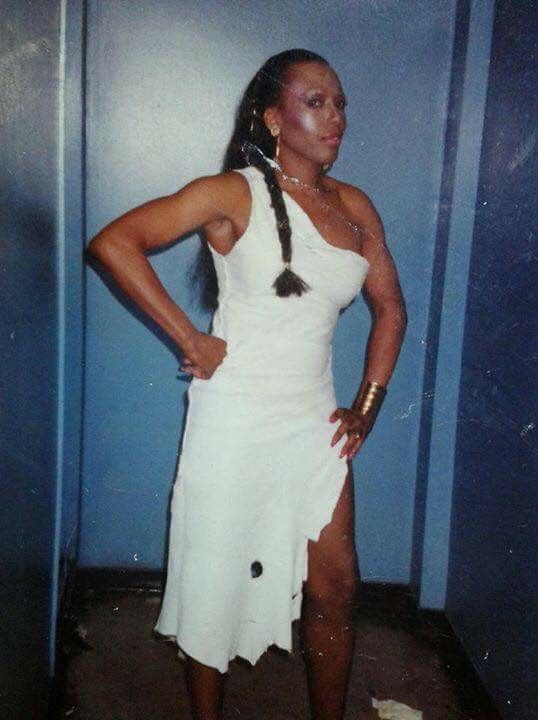
Lucy Hicks Anderson (1886–1954) was an African-American socialite and chef best known for her time spent in Oxnard, California, from 1920 to 1946. She was assigned male at birth but adamant from an early age that she was a girl, and supportive parents and doctors reaffirmed her in living as one. She established a boarding house in Oxnard, where she became a popular hostess. In 1945, a year after she married her second husband, she was arrested and tried and convicted of perjury, as the government said she had lied about her sex on her marriage license. After release from prison, she and her husband moved to Los Angeles. Lucy Hicks Anderson was born in Waddy, Kentucky, in 1886. From a very early age, Anderson was adamant that she was not male, identifying as female in a time period before the term transgender existed, and naming herself Lucy. Doctors told Lucy's parents to let her live as a young woman, so they did, and she began wearing dresses to school and being known as Lucy. At the age of 15, Lucy left school and did domestic work as a means to support herself. At age 20, she headed west to Pecos, Texas, where she worked in a hotel, and then to New Mexico, where she married her first husband, Clarence Hicks, in Silver City, New Mexico in 1920. She later moved to Oxnard, California at the age of 34. A skilled chef, she won some baking contests. Her marriage to Clarence lasted only nine years, but during the course of the union, she saved up enough money to buy property that was a boarding house front for a brothel; it also sold illegal liquor in Prohibition America. Outside of her time as a Madame, she was a well-known socialite and hostess in Oxnard, and would later use her connections to avoid serious jail time. According to scholar C. Riley Snorton, "When the sheriff arrested her one night, her double-barreled reputation paid off—Charles Donlon, the town’s leading banker, promptly bailed her out [because] he had scheduled a huge dinner party which would have collapsed dismally with Lucy in jail." In 1944, Hicks remarried Reuben Anderson, a soldier stationed in Long Island, New York. In 1945, a sailor claimed that he caught a venereal disease from one of the women in Anderson's brothel, so all of the women, including Anderson, were required to undergo medical examination. When the Ventura County district attorney learned from this examination that Anderson had been assigned male at birth, he chose to try her for perjury, arguing that she lied about her sex on her marriage license and impersonated a woman. During the trial, she stated “I defy any doctor in the world to prove that I am not a woman,” and “I have lived, dressed, acted just what I am, a woman.” However, the court convicted her of perjury on her marriage license and sentenced her to 10 years of probation. At the time, marriage was only valid between a man and a woman, and she was not deemed a woman, so the marriage was declared invalid. As a result, the federal government charged her with fraud for receiving the financial allotments wives of soldiers got under the GI Bill, and initially also with failing to register for the draft, until she proved she had been too old to register. In this trial, she and Reuben were found guilty and sentenced to a men's prison, where Lucy was forbidden by court order to wear women's clothes. After being released from prison, Anderson was barred from returning to Oxnard by the police chief, who threatened further prosecution. She and Reuben relocated to Los Angeles, where they resided quietly until her death in 1954, at 68. The Handbook of LGBT Elders calls Anderson "one of the earliest documented cases of an African-American transgender person". One episode of the HBO TV series Equal is based on the life of Lucy Anderson.
Crystal LaBeija was an American drag queen and trans woman who founded the House of LaBeija in 1977. The House is often credited as starting the house system in ball culture. She became a mother figure for homeless LGBTQ youth. LaBeija originally worked and competed on the Manhattan drag circuit under the name of Crystal LaAsia, before changing her name to LaBeija as Latin queens kept calling her La Belleza (Spanish for "the beauty"). In the 1960s and 1970s, drag queens of color were expected to whiten their appearance to help their chances at winning competitions and they often faced racist environments. LaBeija was one of only a few African American drag queens to be awarded a "Queen of the Ball" title at a drag ball organized by whites during this era. In 1967, she was crowned Miss Manhattan. LaBeija subsequently competed in the 1967 Miss All-America Camp Beauty Pageant held in New York City Town Hall, a competition documented in The Queen (1968). In a scene towards the end of the documentary, LaBeija, upset with the perceived racism of the white-run balls, accused the pageant organizer Flawless Sabrina of rigging the judging in the favor of a white queen, Rachel Harlow. Refusing to participate further in a discriminatory system, LaBeija worked with another black drag queen, Lottie LaBeija, to host a ball just for black queens. She agreed to participate in the event so long as she was highlighted in the ball. This event, the first to be hosted by a House, was titled "Crystal & Lottie LaBeija presents the first annual House of Labeija Ball at Up the Downstairs Case on West 115th Street & 5th Avenue in Harlem, NY" and took place in 1972. It was the first time the term "House" was used, coined by LaBeija in order to market the event, which would be a huge success. LaBeija continued to work as a drag performer and activist throughout the 1970s and 1980s. RuPaul's first experience of a drag performance was seeing LaBeija perform a lipsync routine at a nightclub in Atlanta in 1979. In 2019, Rolling Stone reported that LaBeija died of liver failure in 1982. However, the New York Times reported in 1993 that Labeija was still alive and had attended a revival of The Queen at the Film Forum in New York. The article reported that LaBeija was still "a fixture in the drag world" and had a reunion of sorts with contest winner Harlow. "She was very very lovely to me," Harlow is quoted as saying. "She came up to me and kissed me and said hello... She left before the end."
Miss Major Griffin-Gracy (born October 25, 1940), often referred to as Miss Major, is a trans woman activist and community leader for transgender rights, with a particular focus on women of color. She served as the original Executive Director for the Transgender Gender Variant Intersex Justice Project, which aims to assist transgender persons, who are disproportionately incarcerated under the prison-industrial complex. Griffin-Gracy has participated in activism for a wide range of causes throughout her lifetime, including the 1969 Stonewall riots in New York City. Griffin-Gracy was born in the South Side of Chicago on October 25, 1940, and was assigned male at birth. Griffin-Gracy participated in drag balls during her youth, and described her experience in Chicago in a 1998 interview: [The drag balls] were phenomenal! It was like going to the Oscars show today. Everybody dressed up. Guys in tuxedos, queens in gowns that you would not believe— I mean, things they would have been working on all year...And the straight people would come and watch, they were different than the ones who come today. They just appreciated what was going on. Griffin-Gracy also believed that, at the time, she and her peers were unaware they were questioning the gender they were assigned at birth, and noted that much of the contemporary terminology surrounding gender identities did not exist. Miss Major reported that she came out as a transgender woman in the late 1950s. As a transgender woman, Griffin-Gracy was met with a lot of criticism and maltreatment from her peers. In a radio interview, she recalls the need for someone to always be by her side in order to avoid situations where her peers could single her out and violently attack her. At the start of her medical transition, Griffin-Gracy relied on the black market for her hormones. Over twenty years, she suffered from homelessness and participated in sex work. She also participated in other illegal activities, including theft, in order to support herself. Griffin-Gracy has five sons. Christopher was born in 1978. Her three other sons were adopted into her family after meeting them in a California park. The boys were runaways, and had meals together with Griffin-Gracy and her biological son. In September 2020, Griffin-Gracy announced that she and her partner, LGBTQ+ activist Beck Witt (a trans man himself), were expecting a child together. On 9th January 2021, Beck & Miss Major welcomed their son Asiah Wittenstein Major into the world. After having been kicked out of two colleges for the outward expression of her identity, Griffin-Gracy moved from Chicago to New York City. While some organizations, including gay bars in the city, would deny entry to trans women, she established herself within an LGBT community associated with the Stonewall Inn, a bar in Greenwich Village. She recounted, "We could go to Stonewall and everything would be fine, we didn't have to explain ourselves." On June 27, 1969, Griffin-Gracy was in the Stonewall Inn meeting with a girlfriend when the bar was raided, an action which initiated the Stonewall riots. Griffin-Gracy was a leader in the riots, but was struck on her head by a police officer and was taken into custody. She reported that a corrections officer broke her jaw while in prison. She had a five-year sentence at Clinton Correctional Facility in Dannemora for a burglary conviction where she met Frank "Big Black" Smith who had participated in the Attica Correctional Facility riots of 1971. The two of them communicated regularly during her time there, him showing her great respect despite her gender identity. Smith talked Griffin-Gracy through the information that she needed to really help her community—to fix a problem rather than mask it. She was released from Dannemora in 1974 with new hope for her community. Griffin-Gracy moved to San Diego in 1978 and organized community efforts and grassroots movements. She initially started with work at a local food bank and later provided direct services for trans women who were incarcerated, suffering from addiction, or homeless. While in San Diego, the AIDS epidemic struck the United States, and as a part of her service, Griffin-Gracy found herself providing additional healthcare and multiple funerals each week. Griffin-Gracy then moved to the San Francisco Bay Area in the mid 1990s where she served on multiple HIV/AIDS organizations including the Tenderloin AIDS Resource Center. In 2003, Griffin-Gracy began working at the Transgender Gender Variant Intersex Justice Project (TGIJP) shortly after it was founded by Alex Lee, although sometimes she is credited as the founder. She served as the Executive Director of the project, leading efforts to support transgender women who have been imprisoned, particularly women of color. Both within her organization and without, she has fought against criminalization and police brutality. She is credited for leading direct service efforts and personalized care to incarcerated trans women of color with TGIJP in addition to her leadership in previous organizations. Griffin-Gracy views the state of being transgender or genderqueer as one of "living outside the law" due to constant rejection from mainstream audiences, particularly in pursuing job or education opportunities. She also argues that while many people with transgender and queer identities are not imprisoned, their identities and means of expression are policed through social behavior and state policies. She frequently cites the prison industrial complex as a major factor in why transgender people are incarcerated, specifically people of color and those with low income. Griffin-Gracy has discussed the need for activism for transgender persons based in part on stories of discrimination from others. She herself began her journey as a trans activist after being made aware of how many young trans women were being murdered with no response from the world around them. In the 1970s, a friend named Puppy, a Puerto Rican trans woman and sex worker, was found dead in her own apartment. Griffin-Gracy held that there was evidence of a murder, but authorities ruled her death a suicide. Griffin-Gracy described the event and its impact on her in an interview: Puppy's murder made me aware that we were not safe or untouchable and that if someone does touch us, no one gives a shit. We only have each other...So I started looking out for myself … whenever we got into a car [we] would write down as much information as possible. We would try (to)...get a guy to walk outside the car so that everyone could see him, so we all knew who he was if she didn't come back. That's how it started. Since no one was going to do it for us, we had to do it for ourselves. This outlook has fueled much of her activism to date. Griffin-Gracy has frequently criticized the LGBT movement based on its exclusion of transgender persons from participation and positions of leadership, particularly trans people of color, those with low income, and those who have been previously imprisoned. Griffin-Gracy is a self-proclaimed feminist. Her view of feminism is a woman's ability to be both strong and sensitive, and to do so proudly. She made the decision to identify as a feminist when people began questioning her as a parent. She focuses her activism on the safety of young trans women today, a liberal feminist approach. She has noted that her favorite aspect of activist work is the education and hope that it provides to the women in her community. She wishes for the simplest human rights for trans youth, saying: I'd like for the girls to get a chance to be who they are. For young transgender people to go to school, learn like everyone else does, and then get out there and live their lives, not afraid or thinking that the only solution for them is death. In addition to her focus on basic human rights, Miss Major advocates for radical change in her community. She strives to bring attention to the intersectionality of poverty, race, and gender in situations related to incarceration, employment, and mental and physical health. She draws inspiration for her activism from Elizabeth Taylor and Angela Davis. A documentary titled Major! was released in 2015 and portrays Griffin-Gracy's role as an activist and mentor in the transgender community since the 1960s. She describes the film as not only a tool to present to young trans women their history, but as a reminder for herself that young women still need her help.
Julia Grant was the first transgender person to have her transition chronicled on a mainstream UK television documentary in A Change of Sex. In George and Julia, the first of five hour-long film documentaries directed by David Pearson for the BBC, her story attracted an audience of nearly nine million viewers. The series was transmitted on BBC2 as A Change of Sex, and described by Pearson as "intimate, frank and observational". Additional episodes were broadcast until 1999, charting new stages in her life. Grant survived bowel cancer, but suffered from multiple health problems, and died on 2 January 2019, aged 64, following a short illness.
April AshleyMBE (born 29 April 1935) is an English model, actor, and author. She was outed as a transgender woman by the Sunday People newspaper in 1961[1] and is one of the earliest British people known to have had sex reassignment surgery. Her marriage was annulled in a notable court case known as Corbett v Corbett.
Born in Smithdown Hospital in Liverpool, Ashley was one of six surviving children of a Roman Catholic father Frederick Jamieson and Protestant mother Ada Brown,[2] who had married two years before.[3] During her childhood in Liverpool, Ashley suffered from both calcium deficiency, requiring weekly calcium injections at the Alder Hey Children's Hospital, and bed-wetting, resulting in her being given her own box room aged two when the family moved house.[4]
Ashley joined the Merchant Navy in 1951 at the age of 16.[5] Following a suicide attempt, she was given dishonourable discharge[4] and a second attempt resulted in Ashley being sent to the mental institution in Ormskirk at age 17.[5]
In her book The First Lady, Ashley tells the story of the rape she endured before transitioning. A roommate raped her, and she was severely injured.[6]
After leaving the hospital, Ashley moved to London, at one point claiming to have shared a boarding house with then ship's stewardJohn Prescott, later deputy prime minister of the United Kingdom. Having started cross-dressing, she moved to Paris in the late 1950s, began using the name Toni April, and joined the entertainer Coccinelle in the cast of the drag cabaret at the Caroussel Theatre.[5][7]
At the age of 25, having saved £3,000, Ashley had a seven-hour-long sex reassignment surgery on 12 May 1960, performed in Casablanca, Morocco, by Georges Burou. All her hair fell out, and she endured significant pain, but the operation was successful.[5][7]
After returning to Britain, Ashley began using the name April Ashley and became a successful fashion model, appearing in Vogue (photographed by David Bailey[8]) and winning a small role in the film The Road to Hong Kong, which starred Bing Crosby and Bob Hope.[7][9][10]
A friend sold her story to the media in 1961, and the Sunday People outed Ashley as a trans woman. She became a centre of attention and some scandal, and her film credit was dropped.[1][10]
In November 1960, Ashley met Hon. Arthur Corbett (later 3rd Baron Rowallan), the Eton-educated son and heir of Lord Rowallan. They wed in 1963, but the marriage quickly ended. Ashley's lawyers wrote to Corbett in 1966 demanding maintenance payments, and in 1967, Corbett responded by filing suit to have the marriage annulled. The annulment was granted in 1970 on the grounds that the court considered Ashley to be male, but Corbett knew about her history when they married.[5][7][8] This is the case known as Corbett v Corbett.
After a heart attack in London, Ashley retired for some years to the Welsh border town of Hay-on-Wye. In her book April Ashley's Odyssey, she stated that Amanda Lear was assigned male at birth and that they had worked together at Le Carousel where Lear had used the drag name Peki d'Oslo.[4] Ashley was once great friends with Lear,[11] but according to Ashley's book The First Lady, they had a major falling out and haven't spoken in years.
In the 1980s, Ashley married Jeffrey West on the cruise ship RMS Queen Mary in Long Beach, California.[12] In 2005, after the passage of the Gender Recognition Act 2004, Ashley was legally recognised as female and issued with a new birth certificate. The then Deputy Prime Minister of the United Kingdom John Prescott, who knew Ashley from the 1950s, helped her with the procedure.[citation needed]
April Ashley's Odyssey, a biography by Duncan Fallowell, was published in 1982.[4] In 2006, Ashley released her autobiography The First Lady[6] and made TV appearances on Channel Five News, This Morning and BBC News. In one interview, she said "This is the real story and contains a lot of things I just couldn't say in 1982", including alleged affairs with Michael Hutchence, Peter O'Toole, Omar Sharif, Turner Prize sculptor Grayson Perry and Íñigo de Arteaga y Martín, the future 19th duke of Infantado, and others. However, the book was pulled from the market after it was discovered that it heavily plagiarized the 1982 book written about Ashley.[15]
In 2012, Pacific Films and Limey Yank Productions announced a project to create a film about Ashley's life.[16]
Peter O'Toole did not have an affair with April Ashley. He did know her in Spain while filming, but his wife Sian Phillips was with him at the time. Sian said she had no problem with O'Toole being friendly with Ashley, because she knew it was platonic.[17][page needed]
Maryam Khatoonpour Molkara (Persian: مریم خاتون ملکآرا; 1950 – 25 March 2012) was a campaigner for the rights of transgender people in Iran, where she is widely recognized as a matriarch of the transgender community. Designated male at birth, she was later instrumental in obtaining a letter which acted as a fatwa enabling sex reassignment surgery to exist as part of a legal framework.
In 1950, Molkara was born, and was the only child of her father's second of eight wives. Her father was a landowner. Molkara says she always preferred clothes, toys, and activities that were traditionally for girls.
In her adolescence, Molkara went to parties dressed as a woman. Molkara came out as transgender to her mother, but she refused to accept her. This made Molkara decide to take feminizing hormones instead of immediately seeking out surgery. She also dressed and lived as a woman.
In 1975, Molkara traveled to London and learned more about her identity. She states it was there she embraced that she was not gay, but transgender.
Molkara started to write letters to Ayatollah Ruhollah Khomeini, then in exile in Iraq, asking for religious advice about being assigned a wrong gender at birth and having to break out of it. In one of these letters, she said that her gender was clear since she was two years old, as she used to apply chalk to her face to imitate putting on makeup. He had already written in 1963 that corrective surgeries for intersex people is not against Islamic law, and his answer was based on this existing idea rather than developing a new fatwa for transgender people. He suggested she live as a woman, which included dressing as one.
After this, she met with Farah Pahlavi, who gave her support towards Molkara and other transgender individuals wanting sex reassignment surgery.
In 1978, she traveled to Paris, where Khomeini was then based, to try to make him aware about transgender rights.
After the Islamic Revolution, Molkara started to face intense backlash due to her identity. She had to go through many questions, arrests, and death threats. She was fired from her job at the Iranian National Radio and Television, forced to stop dressing like a woman, injected with male hormones against her will, and detained in a psychiatric institution. Because of good contacts with religious leaders, among them Akbar Hashemi Rafsanjani, she was released.
At the start of the Iran–Iraq War, Molkara volunteered as a nurse on the front lines. She said that some of the men she treated thought she was a woman due to her gentleness.
Molkara continued to campaign for her right to get sex reassignment surgery. In 1985, she confronted Khomeini in his home in North Tehran: She wore a man's suit, carried the Quran, and she tied shoes around her neck. This was a reference to the Ashura festival, and also indicated that she was looking for refuge. Molkara was held back and beaten by security guards until Khomeini's brother, Hassan Pasandide, intervened. He took Molkara into his house, where she emotionally pleaded her case, yelling "I'm a woman, I'm a woman!" His security guards were suspicious about her chest, as they thought she could be carrying explosives. She revealed they were her breasts, as she developed them using hormone therapy. Having heard her story, Ahmad Khomeini was touched and took Molkara to speak to his father, where he asked three of his doctors about the surgery in an attempt to make a well-informed decision. Khomeini then decided that sex reassignment surgery was needed to allow her to carry out her religious duties. This resulted in Khomeini issuing a fatwa, meaning he determined sex reassignment surgery to not be against Islamic law. Molkara lobbied for the according medical knowledge and procedures to be implemented in Iran and worked on helping other transgender people have access to surgeries. She completed her sex assignment surgery in Thailand in 1997, because she was dissatisfied with the quality of the surgery in Iranian hospitals. The Iranian government paid for her surgery, and she was able to help establish government funding for many other transgender individual's surgeries.
In 2007, she founded and subsequently ran the Iranian Society to Support Individuals with Gender Identity Disorder (ISIGID, انجمنPersian: حمایت از بیماران مبتلا به اختلالات هویت جنسی ایران), the first state-approved organization for transgender rights in Iran. Before this, she was using her own property in Karaj to help other transgender people receive legal advice and medical care, including post-op care. She continued advocating for other transgender people for years, bailing them out after they're arrested, even knowing she will likely face violence for doing so.
Molkara died in 2012, after suffering from a heart attack at the age of 62.
One Irish maid lived as a man in 19th-century Melbourne for decades. The horrifying story of his discovery and “treatment” speaks to attitudes about transgender people that circulate to this day.
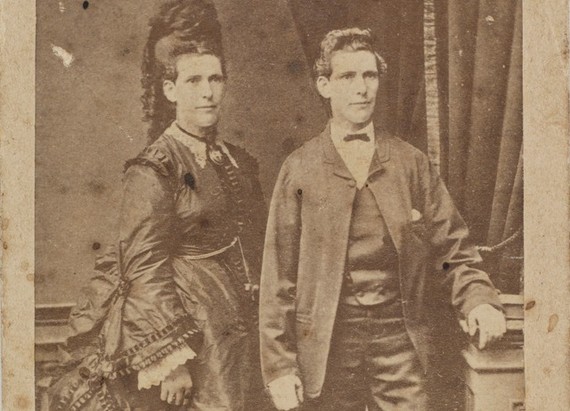
A cut-and-paste portrait of Edward de lacy Evans taken in September 1879. (Wikimedia Commons)
Ellen Tremaye was not like most of the other passengers aboard the Ocean Monarch, a ship sailing from Ireland to Victoria, Australia in 1856. Though the 26-year-old, Irish domestic servant was traveling alone, she brought along a trunk full of men’s clothes labeled “Edward de Lacy Evans,” fueling speculation that she had been abandoned by a suitor after being tricked into bringing his belongings aboard. Then there was her unusual behavior: She wore the same green dress every day, but with trousers and a man’s shirt underneath. She told her fellow passengers that she was going to marry her ship-mate, Mary Delahunty, as soon as they reached Australia, and she reportedly had “intimate friendships” with two other women who shared her bunk at various points in the voyage.
In the late 1800s, Australia was a collection of untamed colonies. Like the American West, it was in the throes of a gold rush, overrun by outlaws, and gradually being settled by increasing numbers of white people. At the same time, it was still governed by Christian and Anglo-Saxon social mores, with male public officials claiming that the declining birth rate could be attributed to “selfish women” who suffered from an overabundance of “love of luxury and social pleasures.”
When Tremaye arrived, she found a job as a maid for a married couple in Bacchus Marsh, northwest of Melbourne. One day when the man of the house was out of town, Tremaye spent the night with his wife, and the husband horsewhipped her when he returned, according to research by Lucy Chesser in the Journal of Women’s History.
Tremaye soon left the job and traveled to Melbourne. We don’t know precisely what drove what happened next, but at this point Tremaye transformed forever. He began using the name Edward De Lacy Evans, started dressing in men’s clothes, and married Delahunty. (In line with Evans’ apparent wish to live as a man, I’ll use male pronouns from this point forward.)
According to accounts from the time, the couple “did not live comfortably together,” and they separated in 1862.
It seemed that Evans’ maleness was accepted by both his wives and neighbors, though his fellow miners occasionally referred to him as “old woman,” Colligan points out, suggesting that his physical womanhood might have been an open secret.
Evans’ third wife, Julia Marquand, eventually had a child by her brother-in-law, sparking bitterness between the couple. He began lashing out at Marquand and her daughter, and he gradually descended into a deep depression.
In 1879, Evans was committed to the Lunacy Ward of the Bendigo Hospital and diagnosed with “amentia,” a general, anachronistic term for mental illness. To avoid being discovered, Evans simply refused to bathe.
After six weeks, however, he was moved to the Kew Asylum, a psychiatric hospital in the Melbourne suburbs. There, he was stripped, and his gender discovered.
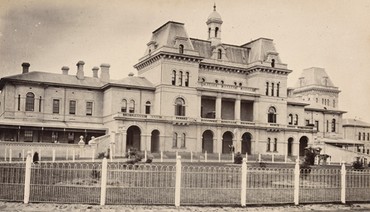
Kew Lunatic Asylum circa 1885 (Wikimedia Commons)
“The fellers there took hold o’ me to give me a bath, an’ they stripped me to put me in the water, an’ then they saw the mistake. One feller ran off as if he was frightened; the others looked thunderstruck an’ couldn't speak. I was handed over to the women, and they dressed me up in frocks and petticoats,” Evans later said of the experience.
Doctors diagnosed him with “cerebral mania” and “mental weakness,” and offered him only female attire to wear. He refused to wear it, or to eat, for days at a time. Over the course of Evans’ three-month treatment, physicians subjected him to extensive vaginal and rectal probing, during which he reportedly “sobbed and wept.”
Marquand later claimed she had no knowledge of Evans’ biological sex—he never let her see him changing, she would later attest. Colligan points out that this is not as far-fetched as it sounds: A few other documented cases of women posing as men at the time involved stories of strap-on dildos used for sex. For Marquand, though, this might also have been a face-saving excuse. She also later claimed that she did not know how she got pregnant, and that she must have mistaken an intruding “real man” for Evans when he snuck into her house.
Evans’ exposure caused, to put it mildly, an incredible stir. One local photographer snuck into the hospital and took photos of Evans dressed in both male and female clothing, as well as in a straight jacket. Local sideshow operators offered the hospital 5 Australian pounds a week to display Evans as an oddity.
After his release, Evans did appear in one such traveling carnival, where reporters noted that he appeared “weak and half-witted” from the ordeal. Sideshows billed him as “The Wonderful Male Impersonator” and a pamphlet about his life, The Man-Woman Mystery, was published in 1880.
The news coverage in the immediate aftermath of the scandal speaks volumes about heteronormative sentiment in the late 1800s. From reading Chesser and Colligan’s accounts, any kind of gender-bending was seen as, at best, a pathology, and at worst, a crime.
Within 24 hours of Evans being outed, a local paper called the Advertiser breathlessly wrote it was, “one of the most unparalleled impostures ... which it has ever been the province of the press of these colonies to chronicle, and we might even add is unprecedented in the annals of the whole world,” as Chesser found.
Other coverage promulgated the idea, which occasionally surfaces to this day, that transgender people are motivated by eroticism, rather than by the feeling that they are trapped in the wrong kind of body.
One newspaper attributed his cross-dressing to nymphomania, writing, “It is evident … that the woman must have been mad on the subject of sex from the time she left Ireland dressed as a woman,” and later celebrated Evans' return to femininity after “treatment:” “Her breasts have almost regained their normal condition; the wrinkles in her face have disappeared, her arms are becoming fleshy, and the scars and marks on them being eradicated.”
The fact that Evans had been discovered while in an asylum only bolstered the idea that he was mentally ill.
"Why she was guilty of the criminal deceptions which she has practised on three women will be understood by medical men as results of the only insanity that effects her, but cannot be explained here," the Bendigo Independent wrote.
It wasn’t Evans’ cross-dressing that so disturbed his contemporaries—there had been other, contemporary instances of women donning men’s garb as a joke or performance—but the fact that he had duped society, and seemingly his own wives, for so long.
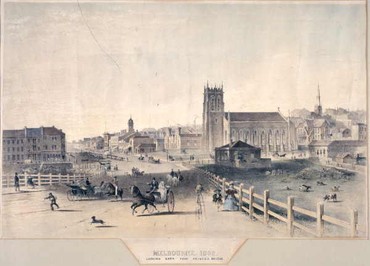
Lithograph of Melbourne in 1862 (Wikimedia Commons)
News reports used quotation marks around both male and female pronouns in describing Evans’ life, somehow implying that he wasn’t truly either. Some reporters speculated that Evans must have become pregnant out of wedlock while on the sea voyage and took on a male identity to hide his shame.
After Evans’ release from the hospital, newspapers reported with satisfaction that he had returned to wearing dresses and looked “quite feminine,” and that he would not again attempt to “unsex herself.”
In the end, Evans wasn’t able to reap much of a fortune from his sideshow appearances. The following year he moved into a Melbourne poorhouse, where he went by “Mrs. De Lacy Evans” and lived for the next 21 years, wearing drab, gray dresses and tending a garden. He died of the flu in 1901.
“The story of Ellen Tremayne is an example of the lengths to which some women had to go in order to live as they wished,” Colligan wrote. “She gave false statements at her ‘marriages’, risked ostracism, and endured exposure to a gaping audience as a show-freak. However, dressing and living as men perhaps gave her a sense of power lacking in her female role.”