Miss Major Griffin-Gracy (born October 25, 1940), often referred to as Miss Major, is a trans woman activist and community leader for transgender rights, with a particular focus on women of color. She served as the original Executive Director for the Transgender Gender Variant Intersex Justice Project, which aims to assist transgender persons, who are disproportionately incarcerated under the prison-industrial complex. Griffin-Gracy has participated in activism for a wide range of causes throughout her lifetime, including the 1969 Stonewall riots in New York City. Griffin-Gracy was born in the South Side of Chicago on October 25, 1940, and was assigned male at birth. Griffin-Gracy participated in drag balls during her youth, and described her experience in Chicago in a 1998 interview: [The drag balls] were phenomenal! It was like going to the Oscars show today. Everybody dressed up. Guys in tuxedos, queens in gowns that you would not believe— I mean, things they would have been working on all year...And the straight people would come and watch, they were different than the ones who come today. They just appreciated what was going on. Griffin-Gracy also believed that, at the time, she and her peers were unaware they were questioning the gender they were assigned at birth, and noted that much of the contemporary terminology surrounding gender identities did not exist. Miss Major reported that she came out as a transgender woman in the late 1950s. As a transgender woman, Griffin-Gracy was met with a lot of criticism and maltreatment from her peers. In a radio interview, she recalls the need for someone to always be by her side in order to avoid situations where her peers could single her out and violently attack her. At the start of her medical transition, Griffin-Gracy relied on the black market for her hormones. Over twenty years, she suffered from homelessness and participated in sex work. She also participated in other illegal activities, including theft, in order to support herself. Griffin-Gracy has five sons. Christopher was born in 1978. Her three other sons were adopted into her family after meeting them in a California park. The boys were runaways, and had meals together with Griffin-Gracy and her biological son. In September 2020, Griffin-Gracy announced that she and her partner, LGBTQ+ activist Beck Witt (a trans man himself), were expecting a child together. On 9th January 2021, Beck & Miss Major welcomed their son Asiah Wittenstein Major into the world. After having been kicked out of two colleges for the outward expression of her identity, Griffin-Gracy moved from Chicago to New York City. While some organizations, including gay bars in the city, would deny entry to trans women, she established herself within an LGBT community associated with the Stonewall Inn, a bar in Greenwich Village. She recounted, "We could go to Stonewall and everything would be fine, we didn't have to explain ourselves." On June 27, 1969, Griffin-Gracy was in the Stonewall Inn meeting with a girlfriend when the bar was raided, an action which initiated the Stonewall riots. Griffin-Gracy was a leader in the riots, but was struck on her head by a police officer and was taken into custody. She reported that a corrections officer broke her jaw while in prison. She had a five-year sentence at Clinton Correctional Facility in Dannemora for a burglary conviction where she met Frank "Big Black" Smith who had participated in the Attica Correctional Facility riots of 1971. The two of them communicated regularly during her time there, him showing her great respect despite her gender identity. Smith talked Griffin-Gracy through the information that she needed to really help her community—to fix a problem rather than mask it. She was released from Dannemora in 1974 with new hope for her community. Griffin-Gracy moved to San Diego in 1978 and organized community efforts and grassroots movements. She initially started with work at a local food bank and later provided direct services for trans women who were incarcerated, suffering from addiction, or homeless. While in San Diego, the AIDS epidemic struck the United States, and as a part of her service, Griffin-Gracy found herself providing additional healthcare and multiple funerals each week. Griffin-Gracy then moved to the San Francisco Bay Area in the mid 1990s where she served on multiple HIV/AIDS organizations including the Tenderloin AIDS Resource Center. In 2003, Griffin-Gracy began working at the Transgender Gender Variant Intersex Justice Project (TGIJP) shortly after it was founded by Alex Lee, although sometimes she is credited as the founder. She served as the Executive Director of the project, leading efforts to support transgender women who have been imprisoned, particularly women of color. Both within her organization and without, she has fought against criminalization and police brutality. She is credited for leading direct service efforts and personalized care to incarcerated trans women of color with TGIJP in addition to her leadership in previous organizations. Griffin-Gracy views the state of being transgender or genderqueer as one of "living outside the law" due to constant rejection from mainstream audiences, particularly in pursuing job or education opportunities. She also argues that while many people with transgender and queer identities are not imprisoned, their identities and means of expression are policed through social behavior and state policies. She frequently cites the prison industrial complex as a major factor in why transgender people are incarcerated, specifically people of color and those with low income. Griffin-Gracy has discussed the need for activism for transgender persons based in part on stories of discrimination from others. She herself began her journey as a trans activist after being made aware of how many young trans women were being murdered with no response from the world around them. In the 1970s, a friend named Puppy, a Puerto Rican trans woman and sex worker, was found dead in her own apartment. Griffin-Gracy held that there was evidence of a murder, but authorities ruled her death a suicide. Griffin-Gracy described the event and its impact on her in an interview: Puppy's murder made me aware that we were not safe or untouchable and that if someone does touch us, no one gives a shit. We only have each other...So I started looking out for myself … whenever we got into a car [we] would write down as much information as possible. We would try (to)...get a guy to walk outside the car so that everyone could see him, so we all knew who he was if she didn't come back. That's how it started. Since no one was going to do it for us, we had to do it for ourselves. This outlook has fueled much of her activism to date. Griffin-Gracy has frequently criticized the LGBT movement based on its exclusion of transgender persons from participation and positions of leadership, particularly trans people of color, those with low income, and those who have been previously imprisoned. Griffin-Gracy is a self-proclaimed feminist. Her view of feminism is a woman's ability to be both strong and sensitive, and to do so proudly. She made the decision to identify as a feminist when people began questioning her as a parent. She focuses her activism on the safety of young trans women today, a liberal feminist approach. She has noted that her favorite aspect of activist work is the education and hope that it provides to the women in her community. She wishes for the simplest human rights for trans youth, saying: I'd like for the girls to get a chance to be who they are. For young transgender people to go to school, learn like everyone else does, and then get out there and live their lives, not afraid or thinking that the only solution for them is death. In addition to her focus on basic human rights, Miss Major advocates for radical change in her community. She strives to bring attention to the intersectionality of poverty, race, and gender in situations related to incarceration, employment, and mental and physical health. She draws inspiration for her activism from Elizabeth Taylor and Angela Davis. A documentary titled Major! was released in 2015 and portrays Griffin-Gracy's role as an activist and mentor in the transgender community since the 1960s. She describes the film as not only a tool to present to young trans women their history, but as a reminder for herself that young women still need her help.
Total Pageviews
Sunday, December 19, 2021
Sunday, October 3, 2021
Deborah Hartin
Deborah Marie “Debby” Hartin (September 15, 1933 – March 15, 2005) was an American lecturer and activist. Her 1970 divorce following a gender transition made national headlines, and she went on to appear on numerous talk shows. Hartin was selected by The Book of Lists as one of ten renowned trans women, and she was featured in the 1978 documentary Let Me Die a Woman. Prior to transition, Hartin served in the United States Navy starting in 1953. While stationed in Pensacola, Florida, Hartin married, and the couple had a daughter in 1955. The marriage led to a separation in 1957, and after moving to Casablanca in 1966, Hartin transitioned in 1970. Her divorce that year made headlines, one of the first publicized divorces due to transition. In 1971, Hartin brought suit against The Bureau of Records and Statistics within the New York City Department of Health and Mental Hygiene for refusing to update her sex designation on her birth certificate. Under pressure to accommodate trans citizens, the Bureau had voted unanimously to omit a sex designation from the amended birth certificates of transsexual people. Hartin's suit Deborah Hartin v. Director of the Bureau of Records and Statistics was dismissed in 1973. Hartin told reporters she planned to convert to Judaism in 1976. Soon after, she stopped making media appearances.
Sunday, August 15, 2021
Jacaqueline Charlotte Dufresnoy aka Cocoinelle
Jacqueline Charlotte Dufresnoy (23 August 1931 – 9 October 2006), better known by her stage name Coccinelle, was a French actress, entertainer and singer. She was transgender, and was the first widely publicized post-war gender reassignment case in Europe, where she was an international celebrity and a renowned club singer.[1]
Contents
Life and career[edit]
Born in Paris at rue Notre Dame de Nazareth Nr. 66 in the 3rd arrondissement of Paris, she took the stage name Coccinelle (French for "ladybug") when she entered show business, making her debut as a transgender showgirl in 1953 at Chez Madame Arthur where her mother was a flower seller. She later performed regularly at the famous nightclub Le Carrousel de Paris, which also featured regular acts by other famous trans women such as April Ashley and Marie-Pier Ysser.
In 1958, she travelled to Casablanca to undergo a vaginoplasty by Georges Burou. She said later, "Dr Burou rectified the mistake nature had made and I became a real woman, on the inside as well as the outside. After the operation, the doctor just said, 'Bonjour, Mademoiselle', and I knew it had been a success."
She sang the title track of Premier rendez-vous, a 1941 film directed by Henri Decoin. She became a media sensation, and performed the Cherchez la femme revue which ran for 7 months at the Olympia in Paris between 1963 and 1964. In 1987, her autobiography was published, titled Coccinelle par Coccinelle.
She married French journalist Francis Bonnet in 1960 and was married legally by the French Roman Catholic Church after her legal name change and rebaptism. Her marriage to Bonnet was dissolved in 1962. She then married Paraguayan dancer Mario Costa in 1963, who died in 1977. She then married fellow transgender activist Thierry Wilson in 1996.
Media sensation[edit]
She very quickly became a media sensation upon her return to France after the operation, with a look and stage act based on the prominent sex symbols of the day. Historian Joanne Meyerowitz wrote "the more sexualized MTF showed up in the sensationalized press in the stories on Coccinelle, who worked at Le Carrousel in Paris".[2][3] In 1959 she appeared in Europa di notte by director Alessandro Blasetti. That same year, Italian singer Ghigo Agosti dedicated the song Coccinella to her, provoking widespread consternation and controversy. Coccinelle appeared in the 1962 film Los Viciosos and was the first French trans woman to become a major star, when Bruno Coquatrix splashed her name in red letters on the front of Paris Olympia for her 1963 revue, Cherchez la femme. She later appeared in the 1968 film Días de viejo color. In Israeli slang, the word coccinelle (by Hebrew transliteration - קוקסינל, pronounced [koksiˈnel]) is used as a synonym for transgender, often derogatorily (and also as a general slur for a feminine man).[4]
Activism and later life[edit]
Coccinelle worked extensively as an activist on behalf of transgender people, founding the organization "Devenir Femme" (To Become Woman), which was designed to provide emotional and practical support to those seeking gender reassignment surgery. She also helped establish the Center for Aid, Research, and Information for Transsexuality and Gender Identity. In addition, her first marriage was the first union to be officially acknowledged by the government of France, establishing transgender persons' legal right to marry.[5] Her 1987 autobiography Coccinelle was published by Daniel Filipacchi.[6]
Coccinelle was hospitalized in July 2006 following a stroke. She died on 6 October at Marseille.[7]
Discography[edit]
Coccinelle No 1 (President Records No 38." cda 1052)
- Tu t'fous de moi [You don't care about me]
- L'Amour a fleur de coeur [Love has a heart like a flower]
- Prends-moi ou laisse-moi [Take me or leave me]
- Tu es là [You are there]
Coccinelle No 2 (President Records No 12" cda 1052)
- Je cherche un millionnaire [I'm looking for a millionaire]
- Avec mon petit faux-cul [With my little false bottom]
Coccinelle - 4 chansons de la Revue de l'Olympia "Chercher la femme" (RCA VICTOR 86.012M - 1963)
- Cherchez la femme [Look for the woman]
- On fait tout à la main [Everything is done by hand]
- C'est sûrement vous [It's probably you]
- Depuis toujours [Since forever]
Star du Carrousel de Paris CD (Marianne Melodie 041625) Compilation of 20 titles.
Sunday, July 4, 2021
Patricia Morgan (transgender woman)
Patricia Anne Morgan (also known as Patricia Anne Glavocich,[1] born Henry Peter Glavocich, 12 March 1939[2][3] – died 1986?[1]) was an American businesswoman and former sex worker who became, in the early 1960s, one of the earliest people to undergo gender reassignment surgery in the United States.[4]
She was one of the patients of the pioneering surgeon Elmer Belt.[5] In 1973, she published her autobiography, The Man-Maid Doll,[3][6] in which she describes her experience of early experimental surgery in detail.[7]
Patricia Morgan (1939 - ?1986) sex worker, business woman.
At age eleven, after a mutual undressing with a girl downstairs, the juvenile authorities put him in a boys home. Each time he ran away they put him in the home’s jail, where he was raped.
After three years he was released to live with an aunt, where he was raped by her husband. Later, living with another aunt, he tried on his female cousin’s clothes.
At fourteen he started shining shoes, first in Hoboken, and then on 42nd St in Manhattan. He became friends with Shelley, a male prostitute. He made good tips from gay men but refused their sexual offers. At fifteen he ran away and as Pat became a male prostitute.
Six months later he started dressing as female. With some friends he went shoplifting, and then with Shelley robbed a prospective trick. Pat was sentenced to three years at Elmira Reformatory, where he met the man he loved, William Hurst. William got out first, but was back inside by the time that Pat got out.
Pat returned to male sex work. He met a transsexual for the first time, and then Shelley and another of his friends went to California and returned as women.
Pat started taking female hormones, and began living full-time as female. She learned how to have sex with a man without his realizing that she had male organs. She was saving seriously for the $5,000 plus expenses for the operation. She was arrested as a female prostitute, got through the strip search without being read, and declared herself as a ‘boy’ only in court. She was released in that the prostitution law applied only to women.
She made arrangements through Harry Benjamin, and flew to Los Angeles in 1961 for surgery with Dr Elmer Belt. While waiting for a hospital bed, she was in a car crash with a drunken john. She sued the john, a movie producer, to cover her medical bills, and they settled out of court.
After four months in Los Angeles, Pat had a penectomy and her testicles implanted in her abdomen. Two months after that she had a vaginoplasty. Afterwards she was in pain, very weak and her money had run out.
She moved in with Shelley, but was gang raped by two of Shelley’s tricks. Later they were arrested and Pat was charged with living in a house of prostitution. She served 30 days in the prison hospital. She developed urinary problems and had to have a third operation with Dr Belt.She hustled to raise the airfare to go home. Back in New York she took up prostitution again. She had breast implants to 42DD but then reduced to 38D. She also had her nose straightened. She was booked for prostitution when she accepted a ride in the rain. Her lawyer tried to get her off on the technicality that she was still a man, not having changed her name or birth certificate. The judge ruled that she was a female anyway, and gave her a suspended sentence.
She did change her name shortly afterwards to Patricia Anne Glavocich. Patricia Morgan was her professional name. She started a business of limousines with female chauffeurs, but it lasted only a year. She also did modeling.
Returning to prostitution she tricked with many celebrities, whom she diplomatically does not name. In 1971 William Hurst escaped from prison just before he was due to released. Pat thought that he was released, but he had changed so much that she did not love him any more. He was re-arrested for bank robbery and murder.
Pat developed a friendship with an older man who put up money for her to buy a candy store, and then the building that it was in, and the one next door. She became a landlady.
++In 1973 she published her autobiography as told to Paul Hoffman.
++Apparently she died in 1986, as there is a grave in the name of Patricia Glavocich in New Arlington, New Jersey. She was then 46.
*Not the keynote speaker, nor the sociologist, nor the artist.
- Patricia Ann Morgan. "How I Changed My Sex". Female Mimics, 1,3, 1963. Online.
- Patricia Morgan as told to Paul Hoffman. The Man-maid Doll
. Secaucus, NJ: Lyle Stuart, Inc 123 pp 1973.
Arrangements were made in advance, but she still had to wait four months after arrival in Los Angeles before the operation. This would exhaust most people’s savings, and anyone in a more conventional line of work would lose their job!
According to this site, the US inflation factor from 1961 to 2007 is 7.1210. Therefore Belt’s operations cost over $35,600 in modern money.
On the second prostitution trial, the judge ruled that Pat was a woman. Another legal precedent that was never used elsewhere. See also Francis Carrick.
In my article on Elmer Belt, I mentioned that it was his standard procedure to push the testicles into the abdomen. Diane Kearney replied to this: “Pat Morgan was a friend of mine and she did have the final surgery but you make it seem she was simply a half woman for her entire life with testicles in her abdomen. Not true!”. If Diane is in Pat’s book under a pseudonym, she is well disguised. If she ever ever read Pat’s book, she must have forgotten it. On page 53 Pat summarizes what Dr Belt does with the testicles. I couldn’t find the reference when I first replied to Diane.
Now, which movie producers are known to have had a car crash in Los Angeles in 1961?
Thursday, July 1, 2021
Lenette and Lauraine Lee, 1970
From the St. Paul Pioneer Press.
The Lee sisters (formerly the Lee brothers) participated in the University of Minnesota’s “Transsexual Research Project” during the late 1960’s. They’re posing here under the marquee of the Orpheum Theater in downtown St. Paul, Minnesota. Note the movie which was featured, which of course is the reason of being for the photograph
Monday, June 14, 2021
Colette Berends: Her life and her art
Webpage composed and edited by Lynn Conway
Photos and Art Copyright © 2003-2005, by Colette Berends
All rights reserved
It is with deep sadness that I report the passing of Colette Berends on April 23, 2012.
A true pioneer in life and as an artist, her vibrant spirit lives on
in our fond memories and her creative works.
Dear Colette, may you rest in peace.
http://ai.eecs.umich.edu/people/conway/TSsuccesses/Colette/Condolences_for_Colette_Berends.en.pdf (EN)
http://www.condoleanceregister.nl/img/rouwkaarten/3923.pdf (NL)
http://www.condoleanceregister.nl/Condoleance-Colette-Berends.html
Colette Berends (Netherlands)
[ October 13, 1934 - April 23, 2012 ]

[ click on photo for larger view ]
- This page is dedicated to Colette Berends, and contain articles and stories about her remarkable life and wonderful art. The page is now being augmented, as we collect weblinks, articles and photographs that tell her story and show some of her artistry.
- As a beautiful young entertainer in the Netherlands, Colette began her transition from MtF during her early twenties. For fifteen long years she worked in showbiz, working '"everywhere" in Europe and North-africa, "swallowing hormones and saving for operations". Colette completed her TS transition in 1971, undergoing SRS by Dr. Georges Burou in Casablanca, Morocco. She went on to further fame as an entertainer, and has travelled over much of the world. Later in life Colette became the owner-operator of a beauty salon in Zwolle in the Netherlands. Always a very creative person she also began her explorations in textile artistry, and that work that has since won her many awards.
Colette in 1968 Colette in 1980 in Zurich

[ photos from "Van jongen tot vrouw met allure", Zwolsche Courant, 21 maart 1986 ]
- Now 68 years of age, Colette enjoys working part-time at her salon. This enables her to spend plenty of time on her textile artistry, and on teaching others the special techniques of that art form. She also enjoys taking frequent vacation trips with her boyfriend Ton, a steady partner for the past 21 years.
Ton and Colette

On Vacation

- We are now translating articles and webpages about Colette into English and are posting the translations here. Colette has also sent us more photos of her artistry, and we are compiling pages of those photos into a web gallery of her work. To get a glimpse of Colette's life and her art, you can explore the following webpages (you can use FreeTranslation to visualize essentials of stories not yet translated into English):
An article (with photos) about Colette's life: Zwolsche Courant, 21 maart 1986
"From boy to woman with style" (English translation) NEW!
|
An article (with photos) about her textile artistry: Telegraaf, 9-2-1991 "Colette creates unexpected delights" (English translation)
|
Web-gallery of Colette's artistry NEW!
|
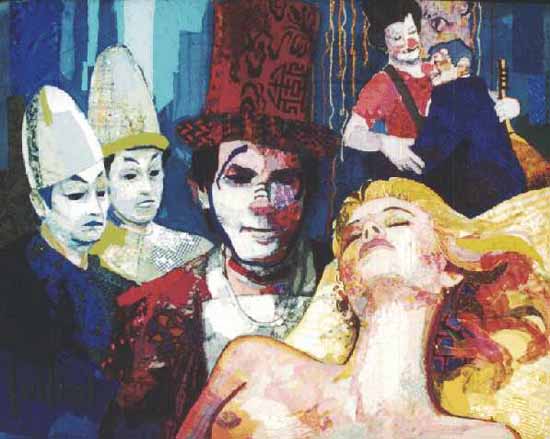
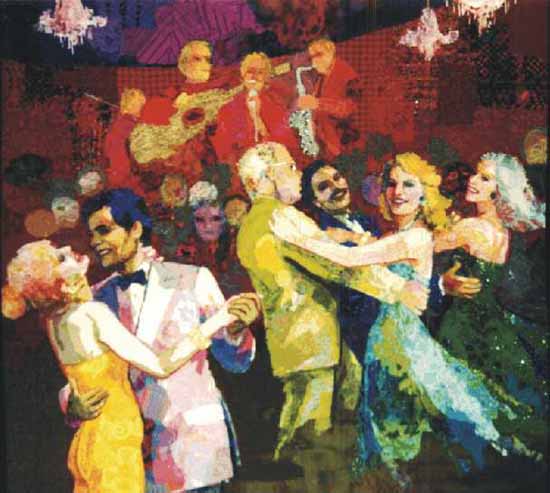
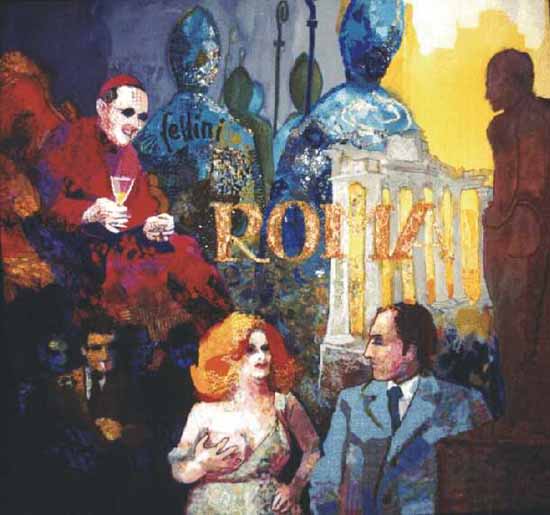
Here is a glimpse of Colette Berends' textile-collage artistry.
(For more examples, see her web-gallery)
De Clowns. Textielcollage, by Colette Berends
108cm x 152cm (1e Prijs European Championship of Quilts 1998) 
Avondje uit. Textielcollage 
Fellini's Roma. Textielcollage 
You may write Colette at the following address: Colette Berends Gombertstraat 32 8031 MA Zwolle NETHERLANDS
Monday, May 10, 2021
The Women of Transvestia
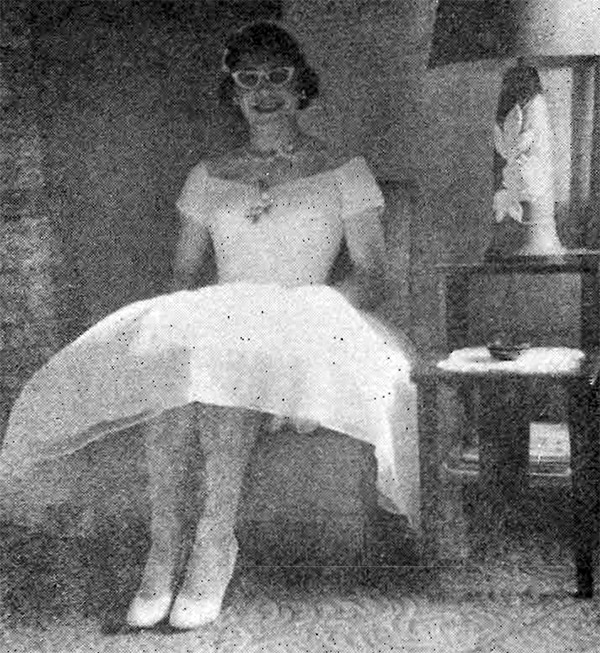
Transvestia was written by its readers and I am fascinated by the first person accounts contained in the magazine. Reading them, I realize how some things never change. The women of that era had the same fears and emotions that we have today.
Their experiences differed from ours because in that era, society abhorred crossdressing. In most places, you could be arrested for crossdressing. As a result, women were very closeted and only the very brave went out among the civilian population.
In addition to the first person accounts, I absolutely adore the photos that accompany the stories.
This was the era in which I was developing as a young woman, so I have an affinity for the fashions that the women wear in the photos. They usually are in their "Sunday best" because they are photo shooting with film and likely will only take a few shots, which they will sneak on a roll containing innocuous family photos. Unless they had a darkroom, they had to take the film to a camera shop or drug store to be developed and printed. Therefore, they had to look presentable so as not to arouse the suspicion of any civilians handling the film.
By the way, I know one woman who built her own darkroom so she could shoot and print photos of her feminine self to heart's content. I'm sure she was not alone.
In honor of the woman of Transvestia, I am posting a selection of their photos here today and in the future. I hope you will find their images as wonderful as I do.
![]() |
| Audrey from New Jersey, 1961 |
![]() |
| Ramblin' Barbara from Connecticut, 1961 |
![]() |
| Carolyn from California, 1961 |
![]() |
| Members of the Los Angeles "Hose and Heels Club," Carolyn, Nancy, Catheryn and Joan, 1961 |
![]() |
| Catheryn mobile in California, 1961 |
![]() |
| Dee Ann from Ohio, 1961 |
![]() |
| Smokin' Doreen from Massachusetts, 1961 |
![]() |
| Gail from New York, 1961 |
![]() |
| Gloria and her twin sister from Pennsylvania, 1961 |
![]() |
| Jane from Kansas, 1961 (Is that her military portrait hanging on the wall?) |
![]() |
| Louise from Ohio, 1961 |
![]() |
| Marilyn from California, 1961 |
![]() |
| Another California girl, Mary, 1961 |
![]() |
| New York's Susanna of Casa Susanna fame, 1961 |
![]() |
| Transvestia cover girl, Terry, 1961 |
![]() |
| Vicki from New York, 1961 |
-
Adult video actress Barbie Woods first began appearing in XXX movies in 2001 when she was 23 years old. Although she became popular pretty q...
-
Sulka born 1962 Sulka from Dallas met Kim Christy in 1979 when she was in the audience at an event in Los Angeles and he was doing the photo...
-
Danielle Foxx was born to a Brazilian mother and a German-American father on November 27, 1979 in Rio de Janeiro, Brazil. Danielle and her p...