 |  | |||||||
 |  | |||||||
 |  | | ||||||
 | ||||||||
|  | | ||||||
 | | | | | ||||
|  |  |  | March 17, 2022 | Advanced Search | |
| | | | |||
| ||||||
| Home>News Center>Life | |
| | |
| | |
| | | | |||||
| | Transgender band 'lady' to issue debut album
|
| | |||||||
| | |||||||
| | | ||||||
| ||||||||
| | | ||||||
| | | | | ||||
| | | | March 17, 2022 | Advanced Search | |
| | | | |||
| ||||||
| Home>News Center>Life | |
| | |
| | |
| | | | |||||
| | Transgender band 'lady' to issue debut album
|
Lucy Hicks Anderson (1886–1954) was an African-American socialite and chef best known for her time spent in Oxnard, California, from 1920 to 1946. She was assigned male at birth but adamant from an early age that she was a girl, and supportive parents and doctors reaffirmed her in living as one. She established a boarding house in Oxnard, where she became a popular hostess. In 1945, a year after she married her second husband, she was arrested and tried and convicted of perjury, as the government said she had lied about her sex on her marriage license. After release from prison, she and her husband moved to Los Angeles. Lucy Hicks Anderson was born in Waddy, Kentucky, in 1886. From a very early age, Anderson was adamant that she was not male, identifying as female in a time period before the term transgender existed, and naming herself Lucy. Doctors told Lucy's parents to let her live as a young woman, so they did, and she began wearing dresses to school and being known as Lucy. At the age of 15, Lucy left school and did domestic work as a means to support herself. At age 20, she headed west to Pecos, Texas, where she worked in a hotel, and then to New Mexico, where she married her first husband, Clarence Hicks, in Silver City, New Mexico in 1920. She later moved to Oxnard, California at the age of 34. A skilled chef, she won some baking contests. Her marriage to Clarence lasted only nine years, but during the course of the union, she saved up enough money to buy property that was a boarding house front for a brothel; it also sold illegal liquor in Prohibition America. Outside of her time as a Madame, she was a well-known socialite and hostess in Oxnard, and would later use her connections to avoid serious jail time. According to scholar C. Riley Snorton, "When the sheriff arrested her one night, her double-barreled reputation paid off—Charles Donlon, the town’s leading banker, promptly bailed her out [because] he had scheduled a huge dinner party which would have collapsed dismally with Lucy in jail." In 1944, Hicks remarried Reuben Anderson, a soldier stationed in Long Island, New York. In 1945, a sailor claimed that he caught a venereal disease from one of the women in Anderson's brothel, so all of the women, including Anderson, were required to undergo medical examination. When the Ventura County district attorney learned from this examination that Anderson had been assigned male at birth, he chose to try her for perjury, arguing that she lied about her sex on her marriage license and impersonated a woman. During the trial, she stated “I defy any doctor in the world to prove that I am not a woman,” and “I have lived, dressed, acted just what I am, a woman.” However, the court convicted her of perjury on her marriage license and sentenced her to 10 years of probation. At the time, marriage was only valid between a man and a woman, and she was not deemed a woman, so the marriage was declared invalid. As a result, the federal government charged her with fraud for receiving the financial allotments wives of soldiers got under the GI Bill, and initially also with failing to register for the draft, until she proved she had been too old to register. In this trial, she and Reuben were found guilty and sentenced to a men's prison, where Lucy was forbidden by court order to wear women's clothes. After being released from prison, Anderson was barred from returning to Oxnard by the police chief, who threatened further prosecution. She and Reuben relocated to Los Angeles, where they resided quietly until her death in 1954, at 68. The Handbook of LGBT Elders calls Anderson "one of the earliest documented cases of an African-American transgender person". One episode of the HBO TV series Equal is based on the life of Lucy Anderson.

Crystal LaBeija was an American drag queen and trans woman who founded the House of LaBeija in 1977. The House is often credited as starting the house system in ball culture. She became a mother figure for homeless LGBTQ youth. LaBeija originally worked and competed on the Manhattan drag circuit under the name of Crystal LaAsia, before changing her name to LaBeija as Latin queens kept calling her La Belleza (Spanish for "the beauty"). In the 1960s and 1970s, drag queens of color were expected to whiten their appearance to help their chances at winning competitions and they often faced racist environments. LaBeija was one of only a few African American drag queens to be awarded a "Queen of the Ball" title at a drag ball organized by whites during this era. In 1967, she was crowned Miss Manhattan. LaBeija subsequently competed in the 1967 Miss All-America Camp Beauty Pageant held in New York City Town Hall, a competition documented in The Queen (1968). In a scene towards the end of the documentary, LaBeija, upset with the perceived racism of the white-run balls, accused the pageant organizer Flawless Sabrina of rigging the judging in the favor of a white queen, Rachel Harlow. Refusing to participate further in a discriminatory system, LaBeija worked with another black drag queen, Lottie LaBeija, to host a ball just for black queens. She agreed to participate in the event so long as she was highlighted in the ball. This event, the first to be hosted by a House, was titled "Crystal & Lottie LaBeija presents the first annual House of Labeija Ball at Up the Downstairs Case on West 115th Street & 5th Avenue in Harlem, NY" and took place in 1972. It was the first time the term "House" was used, coined by LaBeija in order to market the event, which would be a huge success. LaBeija continued to work as a drag performer and activist throughout the 1970s and 1980s. RuPaul's first experience of a drag performance was seeing LaBeija perform a lipsync routine at a nightclub in Atlanta in 1979. In 2019, Rolling Stone reported that LaBeija died of liver failure in 1982. However, the New York Times reported in 1993 that Labeija was still alive and had attended a revival of The Queen at the Film Forum in New York. The article reported that LaBeija was still "a fixture in the drag world" and had a reunion of sorts with contest winner Harlow. "She was very very lovely to me," Harlow is quoted as saying. "She came up to me and kissed me and said hello... She left before the end."


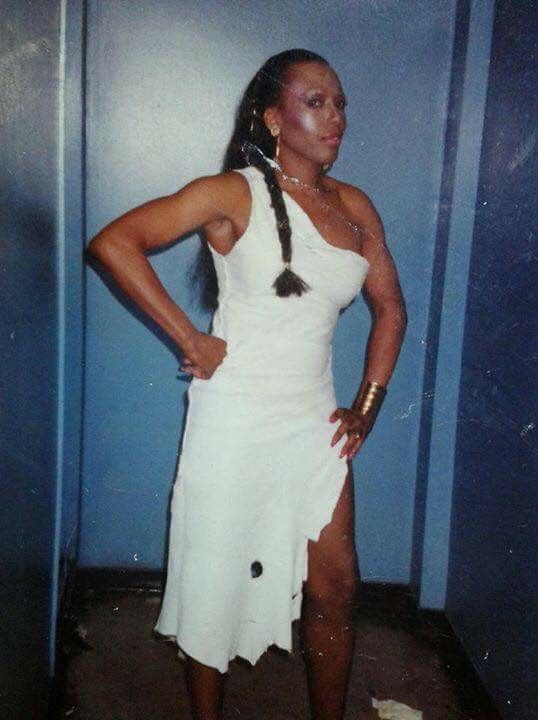

Miss Major Griffin-Gracy (born October 25, 1940), often referred to as Miss Major, is a trans woman activist and community leader for transgender rights, with a particular focus on women of color. She served as the original Executive Director for the Transgender Gender Variant Intersex Justice Project, which aims to assist transgender persons, who are disproportionately incarcerated under the prison-industrial complex. Griffin-Gracy has participated in activism for a wide range of causes throughout her lifetime, including the 1969 Stonewall riots in New York City. Griffin-Gracy was born in the South Side of Chicago on October 25, 1940, and was assigned male at birth. Griffin-Gracy participated in drag balls during her youth, and described her experience in Chicago in a 1998 interview: [The drag balls] were phenomenal! It was like going to the Oscars show today. Everybody dressed up. Guys in tuxedos, queens in gowns that you would not believe— I mean, things they would have been working on all year...And the straight people would come and watch, they were different than the ones who come today. They just appreciated what was going on. Griffin-Gracy also believed that, at the time, she and her peers were unaware they were questioning the gender they were assigned at birth, and noted that much of the contemporary terminology surrounding gender identities did not exist. Miss Major reported that she came out as a transgender woman in the late 1950s. As a transgender woman, Griffin-Gracy was met with a lot of criticism and maltreatment from her peers. In a radio interview, she recalls the need for someone to always be by her side in order to avoid situations where her peers could single her out and violently attack her. At the start of her medical transition, Griffin-Gracy relied on the black market for her hormones. Over twenty years, she suffered from homelessness and participated in sex work. She also participated in other illegal activities, including theft, in order to support herself. Griffin-Gracy has five sons. Christopher was born in 1978. Her three other sons were adopted into her family after meeting them in a California park. The boys were runaways, and had meals together with Griffin-Gracy and her biological son. In September 2020, Griffin-Gracy announced that she and her partner, LGBTQ+ activist Beck Witt (a trans man himself), were expecting a child together. On 9th January 2021, Beck & Miss Major welcomed their son Asiah Wittenstein Major into the world. After having been kicked out of two colleges for the outward expression of her identity, Griffin-Gracy moved from Chicago to New York City. While some organizations, including gay bars in the city, would deny entry to trans women, she established herself within an LGBT community associated with the Stonewall Inn, a bar in Greenwich Village. She recounted, "We could go to Stonewall and everything would be fine, we didn't have to explain ourselves." On June 27, 1969, Griffin-Gracy was in the Stonewall Inn meeting with a girlfriend when the bar was raided, an action which initiated the Stonewall riots. Griffin-Gracy was a leader in the riots, but was struck on her head by a police officer and was taken into custody. She reported that a corrections officer broke her jaw while in prison. She had a five-year sentence at Clinton Correctional Facility in Dannemora for a burglary conviction where she met Frank "Big Black" Smith who had participated in the Attica Correctional Facility riots of 1971. The two of them communicated regularly during her time there, him showing her great respect despite her gender identity. Smith talked Griffin-Gracy through the information that she needed to really help her community—to fix a problem rather than mask it. She was released from Dannemora in 1974 with new hope for her community. Griffin-Gracy moved to San Diego in 1978 and organized community efforts and grassroots movements. She initially started with work at a local food bank and later provided direct services for trans women who were incarcerated, suffering from addiction, or homeless. While in San Diego, the AIDS epidemic struck the United States, and as a part of her service, Griffin-Gracy found herself providing additional healthcare and multiple funerals each week. Griffin-Gracy then moved to the San Francisco Bay Area in the mid 1990s where she served on multiple HIV/AIDS organizations including the Tenderloin AIDS Resource Center. In 2003, Griffin-Gracy began working at the Transgender Gender Variant Intersex Justice Project (TGIJP) shortly after it was founded by Alex Lee, although sometimes she is credited as the founder. She served as the Executive Director of the project, leading efforts to support transgender women who have been imprisoned, particularly women of color. Both within her organization and without, she has fought against criminalization and police brutality. She is credited for leading direct service efforts and personalized care to incarcerated trans women of color with TGIJP in addition to her leadership in previous organizations. Griffin-Gracy views the state of being transgender or genderqueer as one of "living outside the law" due to constant rejection from mainstream audiences, particularly in pursuing job or education opportunities. She also argues that while many people with transgender and queer identities are not imprisoned, their identities and means of expression are policed through social behavior and state policies. She frequently cites the prison industrial complex as a major factor in why transgender people are incarcerated, specifically people of color and those with low income. Griffin-Gracy has discussed the need for activism for transgender persons based in part on stories of discrimination from others. She herself began her journey as a trans activist after being made aware of how many young trans women were being murdered with no response from the world around them. In the 1970s, a friend named Puppy, a Puerto Rican trans woman and sex worker, was found dead in her own apartment. Griffin-Gracy held that there was evidence of a murder, but authorities ruled her death a suicide. Griffin-Gracy described the event and its impact on her in an interview: Puppy's murder made me aware that we were not safe or untouchable and that if someone does touch us, no one gives a shit. We only have each other...So I started looking out for myself … whenever we got into a car [we] would write down as much information as possible. We would try (to)...get a guy to walk outside the car so that everyone could see him, so we all knew who he was if she didn't come back. That's how it started. Since no one was going to do it for us, we had to do it for ourselves. This outlook has fueled much of her activism to date. Griffin-Gracy has frequently criticized the LGBT movement based on its exclusion of transgender persons from participation and positions of leadership, particularly trans people of color, those with low income, and those who have been previously imprisoned. Griffin-Gracy is a self-proclaimed feminist. Her view of feminism is a woman's ability to be both strong and sensitive, and to do so proudly. She made the decision to identify as a feminist when people began questioning her as a parent. She focuses her activism on the safety of young trans women today, a liberal feminist approach. She has noted that her favorite aspect of activist work is the education and hope that it provides to the women in her community. She wishes for the simplest human rights for trans youth, saying: I'd like for the girls to get a chance to be who they are. For young transgender people to go to school, learn like everyone else does, and then get out there and live their lives, not afraid or thinking that the only solution for them is death. In addition to her focus on basic human rights, Miss Major advocates for radical change in her community. She strives to bring attention to the intersectionality of poverty, race, and gender in situations related to incarceration, employment, and mental and physical health. She draws inspiration for her activism from Elizabeth Taylor and Angela Davis. A documentary titled Major! was released in 2015 and portrays Griffin-Gracy's role as an activist and mentor in the transgender community since the 1960s. She describes the film as not only a tool to present to young trans women their history, but as a reminder for herself that young women still need her help.


After a degree at the School of Cinema and Television at the University of Southern California, directing two feature films before the age of 30: Brothers of the Wilderness, 1984, and The Strangeness, 1985, recording many hours of music, marrying as a man and fathering two children, Melanie became involved with the International Foundation for Gender Education and worked with them to produce a VHS Tape on developing a female voice which focuses on voice resonance rather than pitch. In 1991, Melanie took a break from film-making and, with her long-time writing partner Chris Huntley, developed the Dramatica Theory of Story, for which they had first laid the foundations while still at college together. She also began her three-year transition that concluded with surgery with Dr Biber in Trinidad, Colorado. She kept a daily journal during transition which is available online. In 1994 she set up the first online transgender support site, and became one of the most cited advisors on developing a female voice. After three years of full-time effort, the first version of Dramatica (Amazon reviews, WIKIPEDIA) was released. It is one of the most sophisticated software packages for fiction writers, which included a long manual, and supporting videos. Melanie also teaches courses in Dramatica theory through UCLA. In October 2006 in an essay on her Heartcorps site, and reprinted on Gender Life Forum, she wrote: "I've unintentionally perpetrated a great disservice. I've given the impression the anyone can learn to sound completely female in voice as I have. That's why I created the voice video I've been selling for about ten years. Now, I'm not so sure. And in my diary, without ever considering an alternative, I've presented myself as just another transsexual and documented my story in the hope it might smooth the way for others. But now I wonder if it doesn't really foster false hope. … out of all those who have sex reassignment surgery, only a very few have female minds. All the rest, no matter how feminine they have become, have male minds - they don't just think like men, then think as men. ... After all, those who speak in a female voice are as rare as those with female minds, in my experience. Sure, anyone can learn to be more feminine in their speaking, but to actually alter the timber of the voice so it is rich and full but female in resonance, that may be beyond the ability of the rank and file transsexual."However she does insist:"Now, granted, a woman born into a male body is no more entitled to sex change surgery than any man who wanted it. And the standards that they use to determine if you can receive surgery are ignorant, outdated, and laughable, if they weren't so cruel. Honestly, SRS should be available to anyone who wants it, as long as they are certified sane. No RLT should be required. I don't know of a single individual (though there must be some) who determined to have the surgery and then changed their mind because of problems with RLT. And I don't know of anyone who had the grit to go through with the surgery who didn't have what it needs to get through RLT. … Again, there is nothing better or worse about having SRS if you are of male or female mind. And the achievements of anyone from that community who has a female mind and a collection of female physical traits may not be as heroic or laudable as it first appears. They simply may have had more to start with and an easier path because there was less to alter. Ultimately, I think of female minded post-ops as intersexed women rather than transsexual. In some, they are close enough to the range of normal male physical form with fully functioning testicles and no ovaries that no medical professional would class them as hermaphrodites. And yet, possessing many of the traits above, they are truly intersexed in all ways except the reproductive organs." On her web site Melanie describes herself as "parent of two, still married to my spouse of thirty years but living with another woman, my soul mate, for the last eight years". Andrea James' TS Roadmap is dedicated to Melanie for her inspiration.


